Flint: the Ancient Stone That Strikes Sparks from Your Doubt
Are you stuck with a choice that has been sitting on your desk for weeks? Flint is the stone that helps you finally cut through it. For hundreds of thousands of years people have struck sparks from this dark, glassy rock, and that image matches her effect exactly: one focused strike, and there is light. Where endless weighing and reconsidering wears you out and keeps you small, Flint brings you back to the ground beneath your feet and to your own will. In this overview you will read what Flint is, where her name comes from, how to use and care for her, and which Chakras and zodiac signs she resonates with.
What is Flint?
Flint is not a mineral but a rock, built up from cryptocrystalline quartz: silicon dioxide (SiO2) in crystals so small that you cannot see them separately even under an ordinary microscope. That extremely fine structure gives the stone her smooth, shell shaped fracture and her waxy sheen. Flint formed on the floor of shallow chalk seas, where the silica skeletons of sponges and single celled organisms dissolved and, over millions of years, settled again as hard nodules within the limestone. The color, ranging from gray and deep black to brown and beige, comes from organic carbon and fine inclusions. With a hardness of 6.5 to 7 on the Mohs scale, Flint is sturdy enough for jewelry and daily use.
Meaning and History of Flint
The Dutch name vuursteen, literally fire stone, says exactly what matters: strike two pieces together hard, or strike Flint against iron, and sparks fly. The English word flint goes back to the Old High German flins, meaning pebble or hard stone. In the Stone Age, Flint was the most important working material that existed, because every focused tap splits her into a sharp and predictable edge. In the Savelsbos woods near Rijckholt in the southern Netherlands, people dug hundreds of shafts into the limestone between roughly 3950 and 2650 BC to reach good nodules. It is the oldest known mining in the country. Much later the stone lived on in the flintlock of firearms, where a single spark ignited the powder. That history still colors her symbolism: Flint stands for survival, ingenuity and the courage to act.
Physical Properties Flint
Flint is often chosen by people looking for more steadiness in their body. On an energetic level the stone is associated with grounding and with a calm, carrying strength that brings your center of gravity downward. Many people experience Flint as a stone that pulls you out of your head and puts you back into your feet, so the hurried quality leaves your breathing. That grounding energy is linked to stamina and to the feeling that you can handle a long day without pushing yourself too far. Those who hold her in the hand or wear her close to the body often notice that the restlessness in belly and shoulders eases and that there is room to relax again. In this way Flint can offer support in recovering your natural resilience and your own pace.
Please note: gemstones can offer support on an emotional and energetic level, but are never a substitute for medical or professional care. If you have any complaints or concerns, always consult your physician.
Flint and Decisiveness
Decisiveness is the theme Flint is chosen for most often. Her strength lies in the same resolute character the stone has physically: she cuts through hesitation instead of talking around it. Wear a pendant or keep a tumbled stone in your pocket on days when you want to start a conversation or make a decision you have postponed for too long. Place a freeform or a larger raw stone on your desk, right beside the paper or the screen where the choice is waiting. Every time you see it, it reminds you that choosing brings relief as well. Turn it into a small ritual: take the stone in your hand, breathe out calmly and say in your mind what you are actually going to do today. Then take one concrete step, however small. In this way you build more control over your own day, step by step.
Spiritual Properties
Spiritually, Flint is known as a stone of protection and of cutting through. She is seen as a shield that marks out your own energy field, so you are less easily pulled along by the moods and expectations of others. Anyone who quickly adjusts to what someone else needs can find in Flint an ally that helps to draw a boundary and to hold it as well.
The stone is also associated with releasing old ties: convictions, habits or connections that have not served you for a long time, but that you carry with you out of familiarity. Flint is described here as the sharp edge that cuts such a thread, after which space opens for something new. At the same time she works in a deeply grounding way, so that this sharpness does not turn into hardness but is carried by a firm foundation.
There is an old, almost archaic aspect to Flint as well. She is used to make contact with ancestral strength and with the simple knowing that people have carried for thousands of years. Where many soft stones mainly comfort, Flint asks something of you. She invites you to take responsibility and to act on what you already know deep inside.
How to Use Flint?
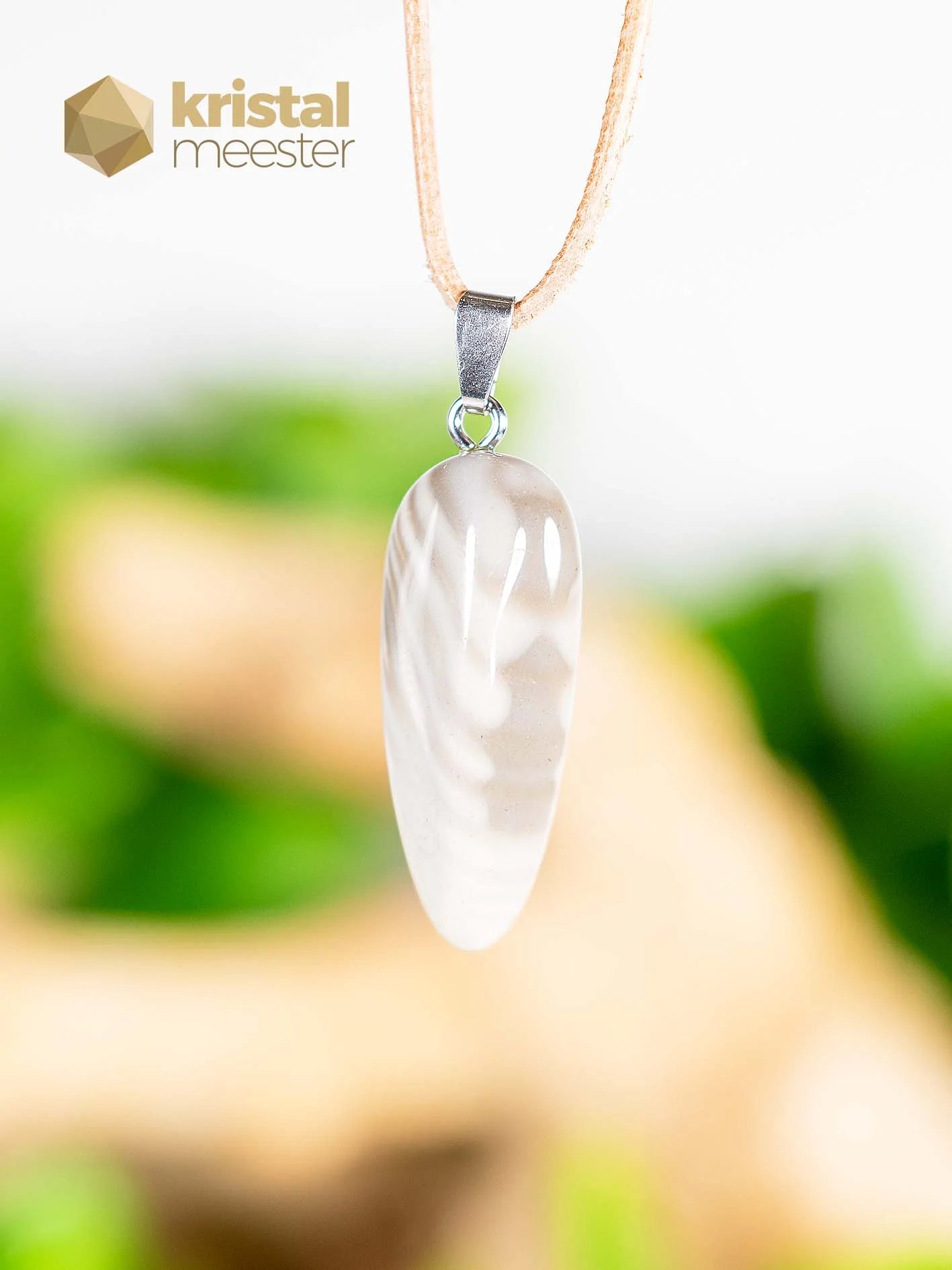
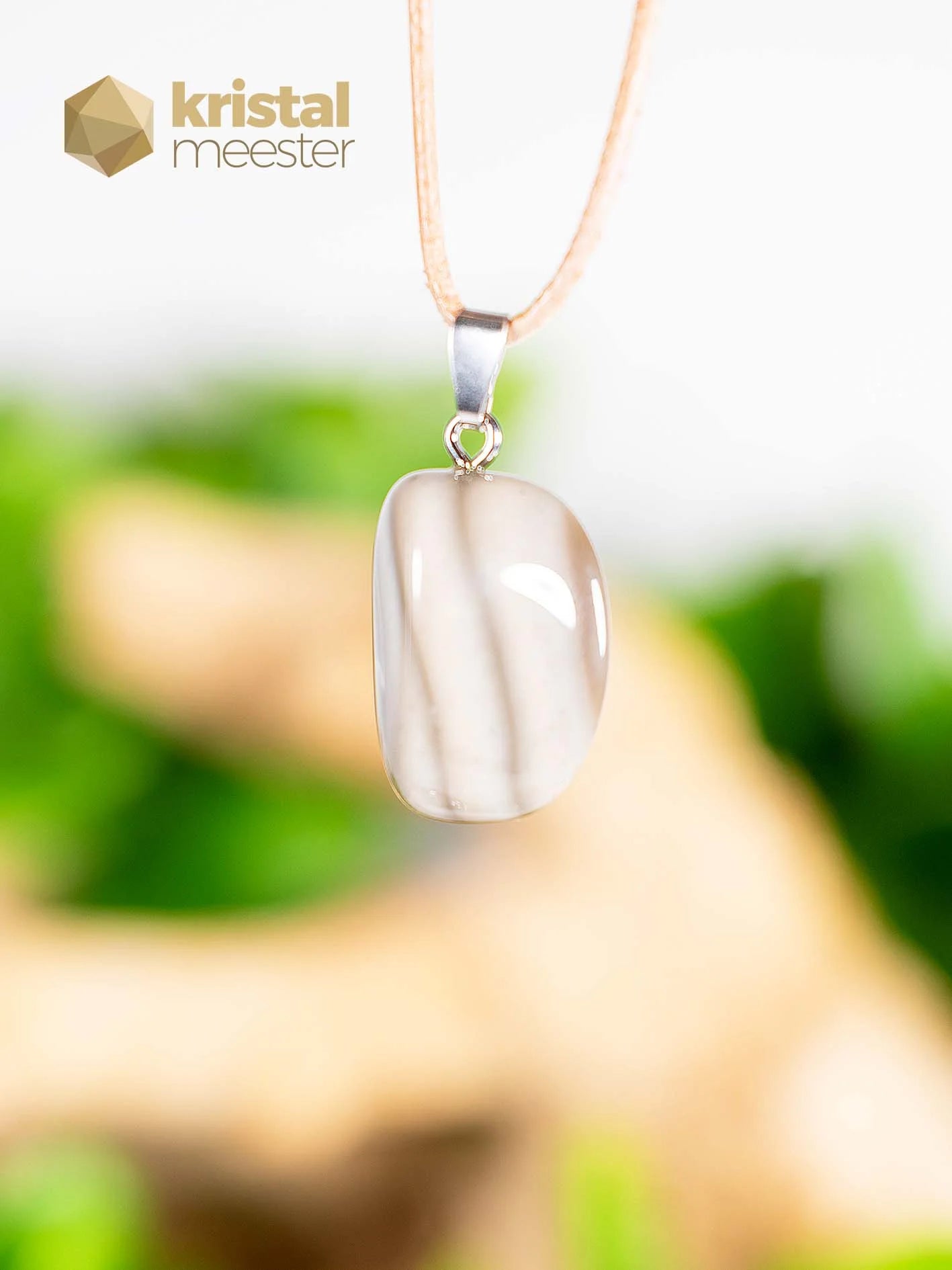
- Wear Flint as jewelry, for example one of our Flint pendants, so her grounding energy travels with you all day.
- Place a freeform or a larger raw stone in the living room or by the front door, for a calm and protected atmosphere at home.
- Hold a tumbled stone in both hands during meditation and bring your attention to your feet and lower back, where your grounding sits.
- Put a small Flint in your pocket or bag as quiet support on days when you have to make a decision.
Types and Varieties of Flint
- Banded Flint: a striped variety with alternating light and dark layers, best known from Poland. It is valued for its calm, rhythmic pattern.
- Red Flint: colored a warm reddish brown by iron oxide. This variety feels more fiery and is often chosen for themes around courage and action.
- Meuse Flint: the fine grained Flint from the southern Netherlands and northeastern Belgium, known in archeology as Rijckholt flint. That even structure is exactly what made it so suitable for working.
- Chert: the broader rock group to which Flint belongs, generally coarser grained and less easy to split.
Beautiful Gemstone Combinations
Amethyst
Amethyst brings calm to the churning that precedes a decision. Where Flint cuts the knot, Amethyst quiets your mind so you can actually hear what you want yourself. Together they form a fine duo for anyone who first needs to settle before choosing becomes possible.
Tiger's Eye
Tiger's Eye adds perspective and self-confidence to the decisiveness of Flint. The golden band of light in this stone stands for clear observation, allowing you to look at a situation from a distance. Flint then turns that view into a decision you also dare to speak out loud.
Smokey Quartz
Smokey Quartz helps with everything you leave behind once the choice is made. This soft brown stone is known for letting go and for deep grounding, exactly where Flint can be short and sharp. The combination is valuable in periods of parting and change.
Properties
- Hardness (Mohs scale): 6.5 to 7
- Density: approximately 2.6 g/cm³
- Composition: SiO2
- Crystal structure: cryptocrystalline, built up from trigonal quartz crystals
- Color: gray to deep black, brown, beige and reddish brown
Locations
- Netherlands
- Belgium
- Denmark
- United Kingdom
- France
- Germany
- Poland
Zodiac Signs
Aries
Aries recognizes itself immediately in the resolute, fiery side of Flint. This sign wants to move forward, but sometimes loses patience halfway. Flint grounds that drive and helps Aries actually finish a decision once it has been made.
Taurus
Taurus feels at home with the heavy, earthy calm of Flint. Where this sign can stay far too long in a situation that no longer fits, the stone gives just enough of a nudge to move. In this way the well known steadiness of Taurus is preserved without becoming rigidity.
Virgo
Virgo likes to analyze until there is nothing left to analyze. Flint draws a line under that and helps this sign take the step from thinking to doing. The practical, sober nature of the stone matches the way Virgo looks at the world.
Chakras
Root Chakra
The Root Chakra is the energy center Flint resonates with most strongly. This Chakra is about safety, grounding and the feeling that you belong somewhere. Flint can feed this center, so you keep both feet on the ground when things become restless around you.
Solar Plexus Chakra
The Solar Plexus Chakra is connected to willpower and self-worth. The resolute energy of Flint kindles this Chakra and helps you stand up for yourself without apologizing. A strong Solar Plexus Chakra makes choosing noticeably easier.
Third Eye Chakra
The Third Eye Chakra is the seat of clarity and inner seeing. Flint supports this center by making the core of a question visible instead of all the side issues around it. In this way you see more sharply which direction truly suits you.
Care
With a hardness of 6.5 to 7, Flint is a robust stone that asks little of you. You can rinse her briefly under lukewarm running water, because her dense structure handles that well. Do not let her soak for hours afterward: many pieces still carry a white, chalky outer layer, and that layer is porous. Pat the stone dry right away with a soft cloth. Avoid sudden temperature differences, such as cold water on a warm stone, because fine cracks can appear in this dense rock as a result. If you want to cleanse Flint energetically, pass her through the smoke of Sage or Palo Santo, or let her rest overnight on a bed of Hematite Chips to cleanse her. To charge her, place the stone on a dish of Rock Crystal Chips, or let her rest overnight in the moonlight. Brief daylight is no problem at all and the color does not fade quickly, but do not leave the stone in bright sunlight for hours or close to a heat source. Finally, store Flint separately from softer stones, because sharp fracture edges can cause scratches.
More information about the cleansing and charging of gemstones can be found in our blog "The cleansing and charging of gemstones".
Frequently Asked Questions about Flint
What does Flint mean?
The name refers to the sparks that appear when you strike the stone hard against iron or against another piece of Flint. Today Flint mainly stands for grounding, protection and the courage to act.
Can Flint get wet?
Yes, a brief rinse under lukewarm running water is fine, since with a hardness of 6.5 to 7 and a dense structure the stone handles that well. Do not let her soak for hours, because the white chalky outer layer of many pieces is porous. Pat the stone dry right away afterward.
Can Flint be placed in sunlight?
Brief daylight is no problem and the color does not fade quickly. Do avoid hours of bright sunlight and sudden temperature differences, because fine cracks can appear as a result. Charging works better in moonlight or on Rock Crystal Chips.
Which Chakra is associated with Flint?
Flint resonates most strongly with the Root Chakra, the center of grounding and safety. She is also connected to the Solar Plexus Chakra and the Third Eye Chakra.
Where is the best place to put Flint?
Flint comes into her own on your desk or workspace, right beside the choice that is waiting for you. She also works beautifully by the front door, where she keeps the atmosphere at home calm and protected. If you prefer to carry her, put a tumbled stone in your pocket.
Summary
Flint is a dark, glassy rock of cryptocrystalline quartz, formed in ancient chalk seas and worked by people since the Stone Age. At Rijckholt in the southern Netherlands she was mined underground thousands of years ago, which makes her one of the oldest working stones in Europe. Energetically, Flint stands for grounding, protection and decisiveness: she helps you cut through doubt and feel in charge of your own choices again. Spiritually she offers a clear boundary and the ability to release old ties, while physically she is associated with resilience and stamina. She resonates with the Root Chakra, the Solar Plexus Chakra and the Third Eye Chakra, and suits Aries, Taurus and Virgo beautifully. Rinse her briefly under lukewarm water, charge her in moonlight and keep her out of prolonged bright sunlight.
If you have any questions about Flint, please do not hesitate to contact Kristalmeester. We are happy to help.